The internationalisation of design services
16 April 2009

The Aragon Centre for Industrial Design CADI has published an interview with Brigitte Sauvage in its informational bulletin, focused on the internationalisation of design services:
But...design services are exported?
Yes, of course. If you are offering services that have your own features, a particular work philosophy, a specific way to focus projects and a particular area of knowledge, these services may be the most appropriate for any company, regardless of their geographic location.
How does a small company like ours end up exporting to China. What could make us decide to do that?
We were working in sectors that manufactured products in large series, such as small home appliances. So, it was common from the mid-90s onward for products that we designed to be manufactured in emerging economies, primarily China. This awakened us to the importance that these countries were going to have, as well as how important it would be to have direct knowledge of how things work there.
On the other hand, we’ve seen a transformation in European companies that “unload” their productive structure, becoming purchasers of products conceived and manufactured in China. To the extent that these products were destined for European markets, we had the knowledge needed to design them, and as such, we could play an important role for Asian manufacturers.
What have been the main difficulties you have encountered in such a different market?
We have had to learn their way of operating, in terms of company philosophies as well as their particular work organisation. And of course, we had to learn the codes governing personal relations in the company.
What are relations like with a customer thousands of miles away and with such different cultural features?
Distance isn’t so important, considering the communications technologies available these days.
However, the cultural differences between East and West are important. We’ve had to readapt our way of working and communicating, be much more flexible, and set up less pre-established and rigid operational structures than those used here. In short, we’ve had to learn how to ‘flow’ with the context instead of ‘dominating’ it, which is how things work in Asian culture.
Have you also worked for the Chinese market itself? What influence does knowledge of the user have on your projects?
Generally, we have worked with products destined for the US or European market, although some have occasionally been marketed in the Chinese market – with the added feature of European Design. Recently we’ve begun to work on products that are specifically destined for the Asian market – an exciting challenge. Our frequent trips to China over the past decade, and our interest in these markets, have helped us tremendously.
Do you only offer conceptual design services, or do you have to cover more stages of product development?
We mostly provide conceptual design services, although we do assure that the development process is monitored in order to guarantee the quality of the manufactured product.
Are you currently exporting, or do you plan to export to new countries?
We export to other European countries, and of course, we don’t rule out exporting to new, emerging countries. It’s not easy, since there is little support for exporting industry services. But we know that we are highly able to adapt, and have solid knowledge in the area of activity that we can offer.
What volume of your turnover is accounted for by exports?
It has been between 30% and 40% of our turnover over the past decade.
What would you recommend to our professional colleagues in terms of setting out on this international direction – are there any helpful institutions?
Undoubtedly the ICEX (Spanish Foreign Trade Institute). There may also be institutions set up by local governments that have established offices in some of the emerging countries in order to support their companies. It’s not an easy path or any kind of panacea. It is a matter of competing on a global level, which requires lots of curiosity and a heavy dose of tenacity and effort – even personal. However, it adds an exciting dimension to our activity while providing us with the kind of global viewpoint so essential today. It also makes us more competent, even when working in our own, nearby market.
Labels: Publications

Arkeologi Museoa
06 April 2009
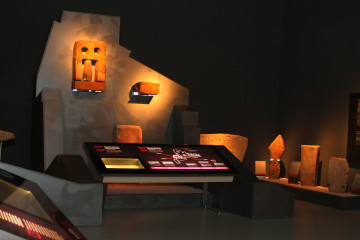
After 36 months of work, the Archaeological Museum of Bizkaia opened its doors on the 2 April, with a threefold aim: to store and manage the territory’s historical and pre-historical heritage; to support research and cataloguing; and finally, to disseminate and promote the value of its collection to the general public.
The new museum is located on the old railway station of the line between Bilbao and Lezama. This five-storey building occupies a 3,000 square metre area and is located on the Plaza de Unamuno in the old quarter (Casco Viejo) of Bilbao.
The museography project, which envisaged a 500 piece exhibition, was developed by a multidisciplinary team integrated by Espiral Ondare, El Plan B and ADN DESIGN. Most of the pieces belong to the archaeological collections of the Basque Museum, while other pieces come from the Museo de Arte Sacro as well as other materials from excavations in progress.
The exhibition, which interior design and display supports have been conceived by ADN DESIGN, shows the living history of the territory through a chronological journey from Pre-historic times to the Modern Age. The visitor can go back 75,000 years in time with the oldest pieces, and progress through the changes undergone by the climate, the landscape, and the customs and habits of the successive settlers who inhabited this territory.
These witnesses of history range from the primitive beauty of a scull from the Iron Age found in San Esteban de Mesterika, to the shipwreck of Urbieta, a vessel used to transport iron mineral dated from the 15th century, one of the centrepieces of the new museum which was recovered recently in Urdaibai. Around such a centrepiece, ADN DESIGN has designed an interesting curved ramp to allow us to get to know the construction technique of the oldest vessel found in the Bay of Biscay to date.
The funerary steles and funerary offerings recovered in the cave Cueva de Pico Ramos in Muskiz, as well as daily use and religious objects recovered from the archaeological site of Forua, are displayed in a succession of successful settings. The carefully designed stands made from different materials exhibit coins, household items, iron wedges and nails, and architectural or sculptural components from various periods.
The public display of archaeological remains is complemented by 19 interactive multimedia and five audiovisual videos, which help to improve our understanding of each section of the new museum.
As José Luis Bilbao, Deputy General of the Provincial Council of Bizkaia said, "Seventy-five thousand years are staring at us from those displays".
Labels: Spaces
Hair diffuser for curl definition
01 April 2009

Backstage Collection, the professional hair styling and hair-dressing line from Solac, has recently been enhanced with the addition of the new diffuser designed by ADN DESIGN with the professional advice of the prestigious hair stylist Óscar Guinea.
The new diffuser creates well defined curls easily and quickly without damaging your hair. As Brigitte Sauvage, Project Director at ADN DESIGN, explained,
The diffuser design is the result of careful research whereby product usability and awareness factors are taken into account, such as aerodynamic or temperature requirements. The speed of air and the temperature reached in each point of the diffuser are very important factors considered through the project design phase.
The inner chamber of the diffuser directs the airflow to create natural curls with a professional finish, while the external cavity, shaped as a bowl with a wavy bottom, gathers the hair to achieve the curly effect desired effortlessly and easily. The size and location of the warm air outflow orifices are carefully designed to obtain defined curls, free from static electricity and to provide the best hair care.
In essence, with this innovative accessory we can now obtain salon results in the comfort of our home.
Labels: Products


